

Ah, the electric vehicle! The silent revolution that promises cleaner air, lower running costs, and a greener future. With each passing year, the buzz around EVs grows louder, especially here in India. From bustling city commutes to ambitious highway journeys, the promise is enticing. But then comes the million-dollar question that always pops up in every car enthusiast's mind, especially when chai-pe-charcha turns to automobiles: "What's the real range, boss?"
We're hurtling towards 2026 at a phenomenal pace, and the automotive landscape is evolving faster than ever. Manufacturers are constantly pushing boundaries, promising bigger batteries, faster charging, and—you guessed it—much longer ranges. But as seasoned drivers on Indian roads, we know that what's promised in glossy brochures and ARAI test cycles doesn't always translate perfectly to the chaotic, beautiful reality of our driving conditions. So, let's buckle up and dive into what we can truly expect from the real-world range of upcoming EVs by 2026, especially for us Indians.
The Hype Machine: What Are Manufacturers Promising for 2026?
The electric vehicle industry is a hotbed of innovation. Talk to any EV maker today, and they’ll paint a picture of a future where range anxiety is a distant memory. For 2026, the expectations are truly ambitious. We’re already seeing claims of 400-500 km range on current models, and by 2026, these figures are projected to climb even higher, with many mainstream models targeting 550-650 km on a single charge based on global testing cycles.
The technological advancements driving these claims are fascinating. We're looking at breakthroughs in battery chemistry, with higher energy density allowing more power to be packed into smaller, lighter battery packs. Innovations like solid-state batteries are on the horizon, promising even greater leaps in safety, longevity, and range. Furthermore, improvements in motor efficiency, aerodynamics, and sophisticated thermal management systems are all contributing to these optimistic projections.

The Ground Reality: Factors That Eat Up Range on Indian Roads
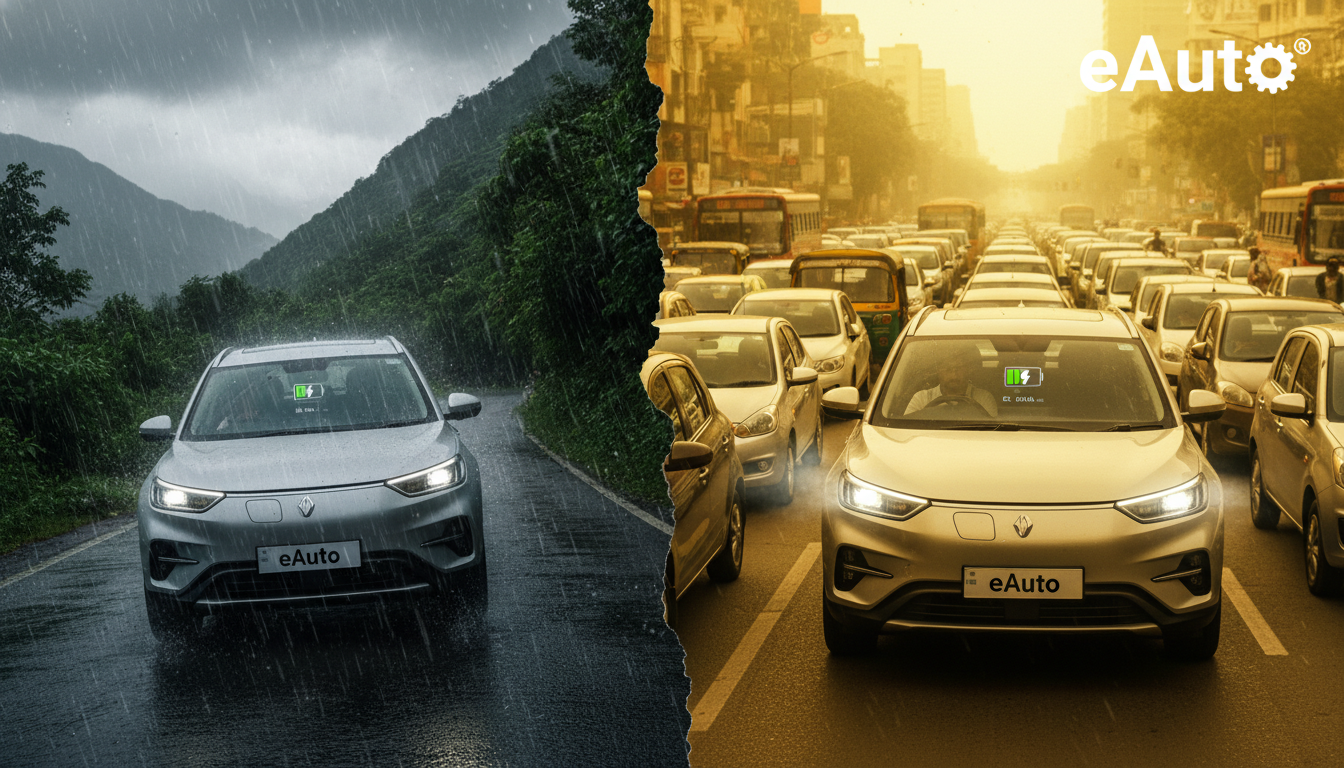
Now, let’s bring it back home. India’s diverse terrain, extreme weather conditions, and unique driving habits are a crucible for any vehicle, electric or otherwise. The ARAI (Automotive Research Association of India) cycle, while providing a standardized benchmark, often doesn't mimic real-world conditions perfectly. Here’s why claimed range figures take a hit once you hit the road:
- Driving Style: The most significant factor. Aggressive acceleration, sudden braking, and high-speed cruising (where permissible) drain the battery much faster than smooth, consistent driving.
- Climate and Temperature: This is huge for India. Blistering summers mean the AC unit works overtime, drawing significant power. Conversely, in colder regions, heating systems and battery conditioning can also consume energy.
- Traffic Conditions: Our infamous city traffic, with its constant stop-and-go patterns, can be a mixed bag. While regenerative braking helps recover some energy, the repeated acceleration from standstill is energy-intensive.
- Terrain and Gradient: Driving uphill, whether in the Himalayas or the Western Ghats, requires more power and thus reduces range. Downhill stretches offer regenerative braking benefits, but it usually doesn't fully offset the uphill consumption.
- Vehicle Load: More passengers or heavy luggage means more weight, which translates to the motor needing to work harder, impacting efficiency.
- Accessory Usage: Beyond AC, using headlights, infotainment systems, phone charging, and other accessories all draw power, incrementally reducing your overall range.
- Battery Degradation: Over years of use and numerous charge cycles, all EV batteries experience some level of degradation, slightly reducing their maximum capacity and thus range.
What Real-World Range Can Indians Truly Expect by 2026?
Given the optimism and the reality checks, what's a pragmatic expectation for an Indian EV buyer in 2026? While global claims might touch 600-700 km, for an average Indian user, factoring in typical driving patterns on our diverse roads, we can generally expect a real-world range to be about 20-30% lower than the officially stated ARAI figures.
This means that a vehicle with a claimed ARAI range of 500 km might realistically deliver anywhere between 350-400 km on a mixed cycle of city and highway driving, with AC usage being a significant variable. For cars claiming 600 km, a realistic expectation would be in the 420-480 km bracket. This is still a substantial improvement over today's typical real-world ranges and will significantly reduce range anxiety for inter-city travel.
- Compact EVs (Entry-level): Expect real-world range of 200-280 km (up from 150-200 km today). Perfect for urban commutes and occasional short trips.
- Mid-range Sedans/SUVs (e.g., Tata Nexon EV, Mahindra XUV400 segment): Real-world range of 300-400 km will become common (current models deliver 250-320 km). This makes weekend getaways much more feasible.
- Premium EVs (e.g., Hyundai Ioniq 5, Mercedes EQE segment): These could command real-world ranges of 400-550 km, making long-distance travel across states a genuinely comfortable proposition with minimal charging stops.

Bridging the Gap: How to Maximize Your EV Range
While the technology is improving, a smart driver can always do more to get closer to the advertised figures. Here are a few tips for our Indian roads:
- Embrace Eco Mode: Most EVs come with an Eco or drive mode that limits power output and optimizes energy consumption. Use it frequently, especially in city traffic.
- Master Regenerative Braking: Learn to anticipate stops and modulate acceleration/deceleration to maximize energy recovery. One-pedal driving, where available, can be a game-changer.
- Pre-condition Your Cabin: Heat or cool your car while it's still plugged into the charger. This uses grid power instead of battery power to bring the cabin to a comfortable temperature.
- Plan Your Trips: Use in-built navigation or apps like Google Maps that can calculate routes and charging stops, giving you peace of mind.
- Maintain Optimal Tire Pressure: Under-inflated tires increase rolling resistance, consuming more energy. Check your tire pressure regularly.
- Sensible AC Usage: While you absolutely need AC in Indian summers, use it judiciously. Don't blast it constantly on max; find a comfortable setting.

The Verdict for 2026: Optimistic, But Grounded
By 2026, the EV landscape in India will be significantly more mature. We'll have a wider variety of models, more robust charging infrastructure, and crucially, improved battery technology delivering genuinely better ranges. The 'real-world' range will certainly be higher than today, making EVs a more viable primary vehicle for many more Indian families.
However, the fundamental factors that influence range—driving style, climate, and terrain—will remain. The gap between advertised and actual range will narrow, but it won't disappear entirely. The key for prospective EV buyers in 2026 will be to look beyond the headline numbers and understand what range means for *their* specific driving needs and conditions. Always factor in a buffer, drive smartly, and enjoy the silent, powerful ride. The future of electric mobility on Indian roads is bright, and with realistic expectations, it's an exciting journey ahead!

